Your Data is Either Making You Millions or Losing You Millions: How to Stay on the Winning Side
- Guest Author
- 23 March 2026
- Blog
- 0 Comments
Your business’s future depends on how you treat your data. Is it driving profit or draining potential?
In every client conversation we have at X-Venture, this question inevitably surfaces: Is your data helping you grow-or quietly holding you back? It’s not just a tech issue. It’s a profit issue. In our work with mid-sized businesses, we’ve seen first-hand how ungoverned data sprawled across systems, owned by no one, and updated by everyone, drains potential faster than most CIOs realize.
Through our governance-first approach, we help companies shift from data chaos to data clarity empowering teams to act faster, spot performance gaps in real time, and reduce operational costs. Because in today’s world, you’re not just competing on product or price. You’re competing on how well you understand and use your data.
What “Losing Money on Data” Really Looks Like?
We once sat down with the COO of a logistics company who said, “We have dashboards. But no one trusts them.” That lack of trust wasn’t just frustrating, it was expensive. Their sales forecasts were consistently off, inventory was mismatched, and every strategic decision was delayed by weeks. Why?
Because the company had no central data ownership. Teams built their own reports off different systems. Nobody knew what was accurate. Invoices went out late. Discounts were duplicated. And over time, millions in potential margin slipped through the cracks.
This story isn’t rare. We’ve seen it across industries:
- A finance team manually reconciling numbers from five spreadsheets
- Marketing pulling performance reports that don’t match operations data
- Senior leadership getting conflicting versions of “truth”
Data wasn’t helping these businesses grow. It was actively working against them.
What Winning with Data Looks Like?
One of our fin-tech clients came to us with a clear but challenging vision. As our governance team put it: “The challenge was to make data well-managed and easy to find, understand, use, and govern.”
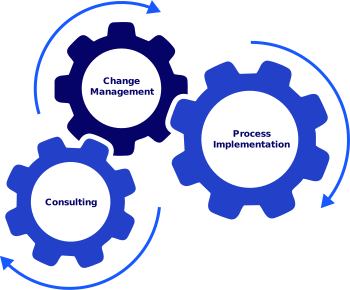
We partnered closely with their leadership to bring this to life through:
- Consulting
We assessed their data maturity and designed a custom governance framework aligned with local and global compliance standards like GDPR and PDPA. - Change Management
We worked across teams to embed new ownership models, establish data stewards, and align teams on governance priorities. -
Process Implementation
Our engineering and integration teams established reliable data ingestion pipelines, automated reporting workflows, and ensured integrity across the board.
The results were immediate: reporting cycles dropped from days to minutes, duplication errors were eliminated, and the company recaptured over $500K annually in unnecessary vendor and operational costs.
They didn’t just become more efficient. They became more confident. Governance turned their data into a strategic lever.
The 3 Foundations of Data-Driven Profitability
From our experience, companies that win with data focus on three governance principles:
- Clear Ownership
Every data domain (sales, customer, financial) needs a named owner. Someone accountable for accuracy, updates, and access.
- Integrated Sources
Centralizing your data doesn’t mean moving everything to one system. It means creating a governed structure that integrates trusted sources so everyone is using the same version of truth.
- Trusted Access
Governance ensures the right people get the right data securely. That builds confidence across teams and eliminates delays caused by second-guessing.
When these three are in place, data becomes a multiplier. Not a mess.
Real Business Example: RBS Customer Data Failure
A Costly Lesson in Poor Governance (2012)
In 2012, the Royal Bank of Scotland (RBS) experienced a major systems failure following a software update to its payment processing system. What began as a routine upgrade quickly escalated into a critical disruption that affected millions of customers across RBS, NatWest, and Ulster Bank.
Customers lost access to online banking, account balances, mortgage services, and international transactions. Payroll processes stalled, and financial reporting was impacted. The root cause? Fragile infrastructure and a lack of proper governance over systems and data handling.
As the issue unfolded over several weeks, reputational damage mounted. In 2014, regulators imposed combined fines of £56 million for the disruption and failures in operational risk controls.
A simple update spiralled into a national crisis. Because the right data wasn’t accessible, and the right people weren’t equipped to respond. Because the right data wasn’t accessible, and the right people couldn’t intervene in time.
A Strategic Comeback through Data & Analytics (2018 onward)
By 2018, RBS had turned things around. The bank invested heavily in advanced analytics, built centralized governance models, and implemented real-time customer service platforms.
RBS uses predictive analytics to personalize customer support, monitor service availability, and proactively prevent downtime.
Their comeback story is a reminder that good data governance isn’t just an IT win – it’s a business recovery strategy.
Why Highly Regulated Industries Are Prioritising Data Governance
What the Future Looks Like with Strong Governance
GDPR
General Data Protection Regulation
A foundational EU law governing how personal data is collected, processed, and stored.
✅ Core to data governance and compliance
📍 Applies to any organization handling EU residents' data
CCPA
California Consumer Privacy Act
A U.S. regulation that gives consumers control over how their personal data is collected and used.
✅ Enables opt-out from data sales
📍 Impacts businesses operating in California
Basel III
Basel III Framework
An international banking regulation focused on risk, capital, and liquidity.
✅ Enforces strict governance of financial and operational data
📍 Critical for data transparency and resilience in banking
Industries like banking, insurance, and healthcare operate in some of the most tightly regulated environments in the world. In these sectors, data governance isn’t just about efficiency. It’s about legal compliance, trust, and survival. Without proper governance, institutions risk exposing sensitive customer data, failing audits, or violating privacy regulations like GDPR, CCPA, or Basel III.
In our experience working with clients in highly regulated sectors, implementing and maintaining compliance is an ongoing challenge, especially as regulations evolve. An effective data governance strategy in these industries must include continuous monitoring and adaptation. That means staying updated on regulatory changes and proactively adjusting data processes and policies to stay aligned. It’s not just about passing audits, it’s about building a governance model that’s resilient, responsive, and built to evolve. For businesses in these sectors, data governance serves as a critical safeguard that ensures transparency, accountability, and resilience.
Before we close, it’s worth noting that even in 2024, major data governance failures are still making headlines. One of Sri Lanka’s leading financial institutions, Cargills Bank, reportedly lost 1.9TB of customer and staff data due to poor data governance and internal access control gaps. The incident resulted in a public backlash, reputational damage, and forced the bank to overhaul its entire cybersecurity and governance framework.
It’s a modern-day reminder that data governance isn’t optional. It’s a risk control, a brand protector, and a profit enabler
What the Future Looks Like with Strong Governance
What the Future Looks Like with Strong Governance
Data Governance as a Service (DGaaS)
A cloud-based, outsourced approach to data governance
DGaaS delivers policy enforcement, compliance, and quality monitoring as a managed service.
✅ Reduces internal complexity
📍 Scales easily across hybrid and multi-cloud environments
Privacy-First Frameworks
Data governance strategies centered around user privacy
These frameworks ensure that privacy is built into every stage of data handling, not just added later.
✅ Aligned with global regulations (e.g., GDPR, CCPA)
📍 Supports trust-driven, ethical data practices
Cloud-Native Governance
Governance models built specifically for cloud environments
Designed to govern real-time, distributed data across platforms like AWS, Azure, and GCP.
✅ Supports auto-scaling and microservices
📍 Enables dynamic policy enforcement and observability
DataOps Integration
Bringing DevOps-style agility into data governance
DataOps enables faster, more reliable data delivery while maintaining compliance and quality standards.
✅ Promotes collaboration between data and IT teams
📍 Automates testing, monitoring, and deployment pipelines
ESG Data Governance
Governance practices for environmental, social, and governance (ESG) metrics
Ensures that ESG-related data is accurate, auditable, and aligned with reporting standards.
✅ Critical for sustainability and investor transparency
📍 Supports frameworks like GRI, SASB, and TCFD
Modern data governance is being reshaped by trends like Data Governance as a Service (DGaaS), Privacy-First Frameworks, Cloud-Native Governance, and DataOps Integration. We’re also seeing rising demand for ESG Data Governance, where sustainability and transparency are just as critical as compliance. Businesses that adapt to these models aren’t just keeping up – they’re building smarter, future-ready ecosystems.
The future isn’t five years away, it’s already here. With AI adoption accelerating and data volumes expanding by the minute, governance is no longer optional; it’s foundational. Businesses that embrace governance today are positioning themselves for greater agility, faster innovation, and sustainable competitive advantage.
At X-Venture, we help you become future-proof by aligning data and AI governance to your business goals, infrastructure, and compliance environment. Whether you’re building from scratch or refining what’s in place, we’re here to make governance work for you - now and tomorrow.
Let's Talk

Marketing Team
Partner - API, AI & Data Governance
- info@x-venture.io
- (+94) 77 40 86 590
We build. We fix. We future-proof
Click to rate this post!
[Total: 1 Average: 5]
Contact
Thank you for interested in reading content more. Please fill the following form to continue
Related Posts

API Economy: Transforming Business Landscape Through Strategic API Adoption.
- Guest Author
- 11 December 2023
The modern digital landscape is leaning heavily on microservices, like Lego blocks of software, ..

How an IT Service Provider Can Accelerate Startups as a Trusted Partner?
- Guest Author
- 28 February 2025
“70% of startups actually fail because of premature scaling. In other words, it’s risky to ..