
AI Without Governance is a Ticking Time Bomb – But Here’s How to Future-Proof It
- Guest Author
- 24 April 2026
- Blog
- 0 Comments
“AI can elevate your business or destroy trust - governance is the difference.”
Companies today have an enormous motivation to integrate AI into their business operations and the numbers prove it.
According to McKinsey’s The State of AI 2025 survey, 78% of organizations now use AI in at least one business function, a sharp rise from 55% 2023 and 72% in early 2024. (https://www.mckinsey.com/capabilities/quantumblack/our-insights/the-state-of-ai)
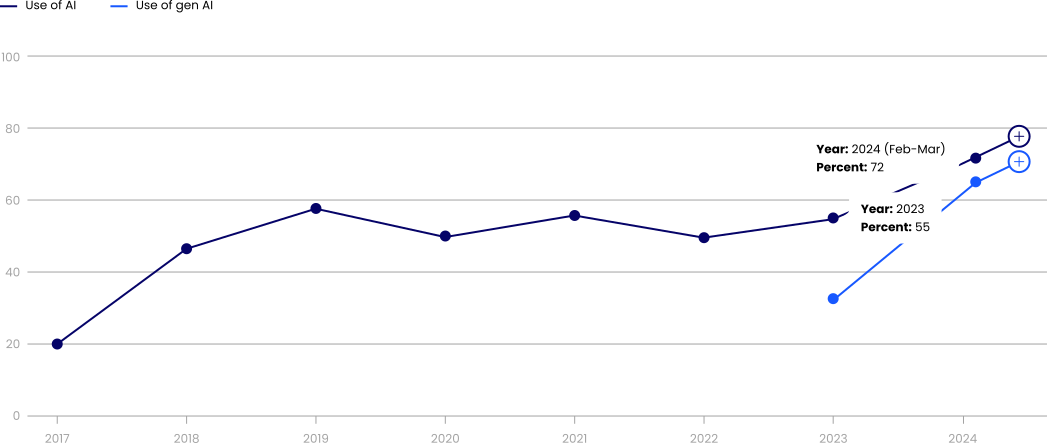
AI Investments Are Surging, but Governance Is Lagging
Gartner’s Market Guide for AI Trust, Risk, and Security Management (AI TRiSM) highlights that AI introduces entirely new categories of trust, risk, and security challenges that conventional controls simply cannot address.
Today’s AI models create risks that are:
- Dynamic: Models evolve over time as they interact with new data, making static risk assessments obsolete.
- Opaque: Complex AI systems, especially composite AI make it difficult to trace or explain decisions.
- Biased: Without intervention, models easily inherit or amplify biases hidden in training data.
- Privacy-Invasive: AI can expose sensitive personal data, intentionally or unintentionally, violating emerging privacy laws.
- Ethically Fragile: AI decisions can cause unfair outcomes, often beyond the reach of existing legal frameworks.
According to Gartner, data and analytics leaders must move beyond traditional IT controls and adopt specialized AI governance capabilities to manage these emerging risks effectively.
That’s why AI, without proper governance, is not just a risk. It’s a ticking time bomb waiting to explode inside businesses.
Every day without action increases the blast radius.
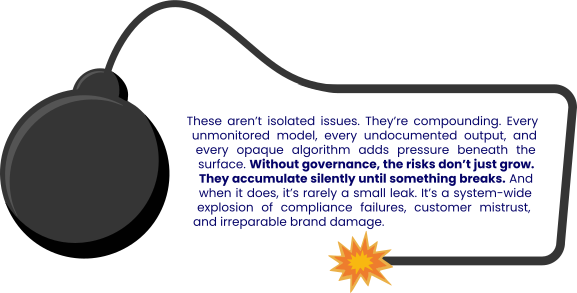
From Pressure to Protection
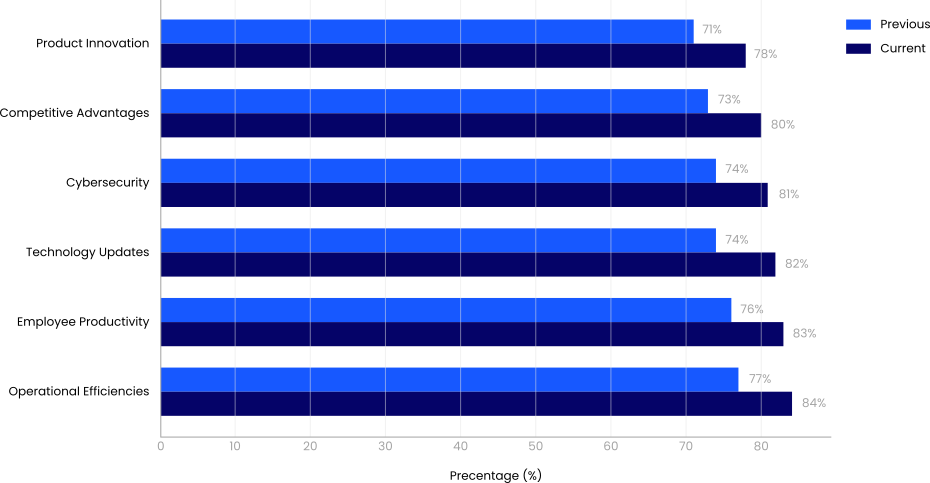
According to EY’s 2024 AI Pulse Survey, a remarkable 97% of senior business leaders report positive returns on their AI investments, with 34% planning to invest $10 million or more in the coming year. These investments are yielding significant benefits:
- Operational efficiencies: 84% (up from 77%)
- Employee productivity: 83% (up from 76%)
- Technology upgrades: 82% (up from 74%)
- Cybersecurity enhancements: 81% (up from 74%)
- Competitive advantages: 80% (up from 73%)
- Product innovation: 78% (up from 71%)
Moreover, there’s a growing recognition of the importance of responsible AI practices:
- 61% of senior leaders report increased interest in responsible AI over the past year, up from 53% six months prior.
- 51% anticipate placing greater focus on AI-related risks in the coming year.
- 59% plan to enhance employee training on the responsible use of AI, up from 49%.
Despite these intentions, only 34% of organizations are building AI governance frameworks at scale, and a mere 32% are addressing bias in AI models comprehensively.
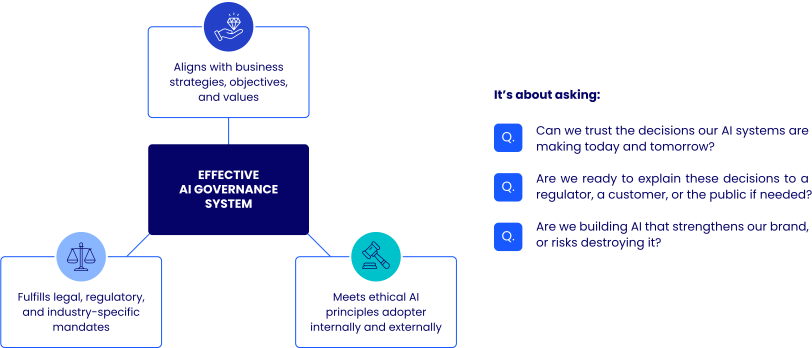
Effective AI Governance starts with a fully committed C-suite and, ideally, an engaged board.

Just like any core business function, AI needs clear rules, oversight, and accountability.
That’s where AI governance comes in.
In simple terms, AI governance means setting the principles, policies, and frameworks that ensure your company’s AI.
Real-world Examples
At X-Venture, we work closely with organizations in some of the most highly regulated industries.
Telecommunication | Logistics | Finance
And one thing is clear: In industries where customer data sensitivity, operational continuity, and regulatory compliance are non-negotiable, AI governance isn’t just about driving ROI or Innovation.
It’s about:
- Ensuring smooth, hassle-free operations even as AI becomes deeply embedded in core processes
- Protecting brand integrity against reputational and regulatory risks
- Maintaining customer trust through transparent, explainable AI decisions
Future-proofing systems to adapt to tightening global regulatory environments
Business leaders are using AI governance as a strategic advantage, not just deploying AI like everyone else.
While many companies rush to implement AI, true business leaders are doing something different:
They are embedding governance at the heart of their AI strategies. Not just to comply, but to outperform.
- MasterCard leverages AI to detect fraud across billions of transactions but insists on strict model auditing and Explainability to ensure regulatory compliance and customer trust.
Through a well-defined governance framework, rigorous review processes, and a commitment to ethical practices, MasterCard ensures that its AI initiatives deliver significant value while upholding the highest standards of responsibility and integrity. As AI continues to evolve, MasterCard’s proactive and strategic approach will undoubtedly keep it at the cutting edge of innovation in the financial industry.
- DHL optimizes global supply chains with AI while embedding governance protocols that control decision-making and minimize operational risks.
As a leading logistics provider operating across jurisdictions like the European Union, DHL recognizes that AI must not only deliver operational efficiency but also comply with stringent data protection. Their governance framework aligns with global standards like GDPR, the European Commission’s Ethical Guidelines for Trustworthy AI, and the California Consumer Privacy Act (CCPA) — but also anticipates the next wave: ethical obligations around data privacy, algorithm security, and responsible AI deployment.
At DHL, safeguarding sensitive customer and proprietary data, ensuring ethical use of AI platforms, and even redefining employee compliance regulations to address AI-integrated tools and collaboration systems.
- Vodafone personalizes customer experiences using AI, overseen by a centralized AI Ethics Board that ensures fairness, transparency, and responsible innovation.
Vodafone’s AI Governance Framework demonstrates a deep commitment to building AI that is ethical, transparent, secure, and human-centric.
Their governance model is anchored around six critical pillars:
- Ethics and Fairness: Ensuring AI outputs are free from harmful bias and discrimination, always empowering humans rather than replacing them.
- Transparency and Accountability: Clearly informing customers and employees when interacting with AI systems, and maintaining full traceability of AI decision-making.
- Privacy and Security: Strictly managing customer data according to GDPR and Vodafone’s own privacy program, ensuring AI systems are secure, permissioned, and respectful of individual rights.
- Human Rights, Diversity, and Inclusivity: Designing AI systems that actively support diversity, accessibility, and societal benefit, aligned with international human rights standards.
- Employee Empowerment: Providing employees with new skills, training, and ethical guidelines to work effectively with AI, while reinforcing a human-in-control approach.
- Right of Redress: Establishing clear pathways for individuals to escalate concerns if they believe they have been unfairly treated by an AI-driven decision.
Vodafone’s framework pledge to continually update their AI policies in response to new technological developments, maintaining dialogue with customers, regulators, academics, and civil society.
It’s Your Turn Now
Above companies aren’t just adopting AI. They’re building governance into its foundation.
If you’re not doing the same, you’re already behind.
To catch up, you must:
- Move governance out of IT silos and into the boardroom
- Establish cross-functional AI governance councils involving legal, risk, HR, and business leaders
- Invest in systems that monitor, explain, and audit AI behavior in real time
- Train employees to understand both the potential and risks of AI
- Align AI development with ethical, regulatory, and brand values
Now, you need the right expertise to build your own way of governance tailored to your risks, your systems, and your future.
What X-Venture Delivers
Across APAC, we’ve helped many logistics and finance leaders to future-proof their automation pipelines ensuring that as AI capabilities grow, their operational trust, regulatory compliance, and brand strength grow with them.
Here’s how we do it:
Our services cover the full lifecycle of AI governance and operational resilience
- Audit existing AI systems to assess risk, fairness, transparency, and regulatory exposure
- Recommend targeted improvements to strengthen existing models and governance workflows.
- Establish AI Governance Frameworks and Responsible Principles
- Specialized AI & Data Governance Consulting
- Conduct AI Risk Assessments
- Secure AI Deployments
- Implementation of Model Context Protocols (MCPs)
- Systematic Responsible AI Testing
- Build Auditing Systems and Explainability Layers
- Ongoing AI Monitoring and Compliance Management
- Address Workforce Impact, Privacy, Security, and Sustainability
- Build Scalable, Future-Ready AI Systems
In a world where AI innovation moves fast, we make sure your governance moves faster.
Let's Talk

Marketing Team
Partner - API, AI & Data Governance
- info@x-venture.io
- (+94) 77 40 86 590
We build. We fix. We future-proof
Click to rate this post!
[Total: 0 Average: 0]
Contact
Thank you for interested in reading content more. Please fill the following form to continue
Related Posts

The Secret Weapon That Turns Struggling Businesses into Market Leaders
- Guest Author
- 19 April 2026
“What do high-performing companies have in common? Clear, enforced data governance.” Downlo ..

How Does the IoT Help Businesses
- Guest Author
- 11 January 2025
Internet of Things How Does the IoT Help Businesses? The Internet of Things (IoT) is revolution ..