Stop Treating Data Like a Spreadsheet – Start Treating It Like a Strategic Growth Asset
- Guest Author
- 23 June 2025
- Blog
- 0 Comments
“CFOs Who Govern Their Data, Govern the Future of the Business”
In a board meeting, a CFO presents monthly numbers. One exec asks for a breakdown of cost variances by region. Silence. The finance team hasn’t aligned cost center changes with regional reporting structures. Why? The data is there. But governed by outdated assumptions and built on siloed spreadsheets.
Sound familiar?
The issue wasn’t technical. It was structural. This company’s financial data wasn’t broken – it just wasn’t governed and streamlined.
Questions Every CFO Should Ask Right Now
As your organization grows and adapts, governance isn’t just the finance or IT teams’ concern It’s a leadership imperative. Here are a few questions every CEO should ask:
- Do we trust the numbers in our boardroom conversations?
- Can our finance systems adapt quickly to structural change?
- How much time does our team spend fixing data instead of using it?
- Are we compliant and audit-ready at any moment?
- Who really owns the data that drives our biggest decisions?
These aren’t technical questions. They’re strategic ones and governance is the answer.
"Decisions are only as good as the data they’re built on. And the data is only as good as its governance."
Spreadsheet Thinking is Holding You Back
Spreadsheets have their place. But in a fast-moving business, they’re not strategic systems. Here’s what happens when finance teams rely on spreadsheets for critical data:
- Data drift: Slight formula or structural changes break analysis chains.
- Version chaos: No single truth, just conflicting reports.
- Lost insight: Time spent reconciling instead of analyzing.
- Slow decisions: By the time answers are aligned, the moment to act has passed.
Finance leaders today need more than accurate data. They need trustworthy, adaptable, and transparent finance intelligence. That requires governance.
Modern Finance Needs Modern Governance
A real-world example of this shift can be seen at AstraZeneca, the global pharmaceutical giant. After years of relying on disparate finance systems across regions, the company implemented a centralized data governance model that harmonized finance reporting structures and standard operating procedures. The result? Faster, more accurate forecasts, streamlined audit processes, and improved financial transparency across the board.
Likewise, Heineken leveraged finance data governance to align global reporting across 80 markets. By replacing scattered spreadsheet logic with a single, governed model, they reduced manual reconciliation by over 70% and dramatically shortened their monthly closing cycle.
Finance data is foundational. It feeds forecasting, investor reporting, tax, risk, M&A evaluations, and strategic planning. But most companies are using models designed for yesterday’s business environment.
True governance means:
- Knowing what data you have, where it lives, and who owns it.
- Having repeatable rules that evolve with your business.
- Connecting finance data with broader organizational goals and doing it in real-time.
"You can't scale finance strategy with spreadsheet logic. You need governance intelligence."
How to Start Evolving - Without Breaking What Works
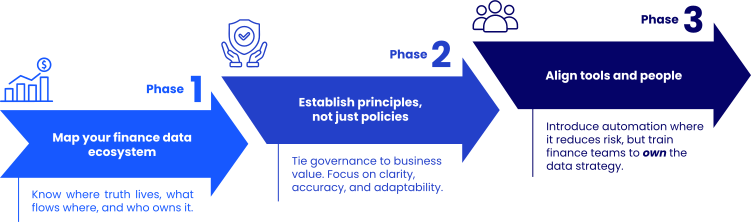
We don’t recommend replacing everything overnight. The transition happens in phases, and that’s where a governance-first mind set makes the difference.
A Success Story
Operating across 12 countries – including Europe, Dubai and Australia — with headquarters in Singapore, this logistics company managed a massive, growing operation across warehousing, freight forwarding, and last-mile delivery.
But under the surface, critical cracks were forming.
Finance teams across their 20 offices still relied on disconnected spreadsheets.
Each country reported using different formats, different financial terms, and under different regulations.
There was no unified template, no real-time visibility, and no reliable single version of truth.
“Consolidating the financials took almost two months,” recalls Peter Hutton, the CFO based in Singapore.
The finance reporting process became a maze:
- Country teams manually submitted spreadsheets to the head office.
- HO teams had to reconcile, standardize, and rebuild reports every cycle.
- Strategic insights were buried under chaos.
- Operational decisions were delayed or made based on incomplete or conflicting data.
The Singapore head office staff found themselves trapped in constant firefighting. Thousands of calls, emails, corrections, and last-minute patch-ups every month. Peter’s staff had to manually chase every country team, verifying mismatched numbers, fixing fragmented templates.
Country offices were helpless. Confused by constantly changing reporting requirements from HO, trying to rewrite and rework reports under pressure, wasting valuable operational time.
No one had real-time financial data. No one trusted the numbers.
The challenge: Aligning scattered finance reports under centralized governance to guarantee compliance, audit traceability, and decision-grade visibility — from country offices to the boardroom.
The solution: X-Venture partnered closely with Peter’s team and transformed their data foundation. Here’s how:
- Delivered a centralized platform to manage finance data integrity, compliance, and quality at scale
- Introduced full transparency of pipelines and audit trails, so leadership could track every decision path
- Automated their ISO compliance reporting, drastically reducing audit fatigue and cycle time
The result:
- Finance became a strategic partner, not a back-office processor
- Monthly reports were reduced from 2-3 months of firefighting to real-time, on-demand dashboards
- Monthly audits moved from reactive clean-ups to proactive, real-time visibility
- Peter now leads board meetings with data he can defend – and decisions he can stand behind
- Finance officers across countries spoke the same data language
"X-Venture didn’t just simplify our finance data. It made governance real. I don’t have to chase the numbers anymore. I know where they live and how they got there."
- Peter Hutton, CFO
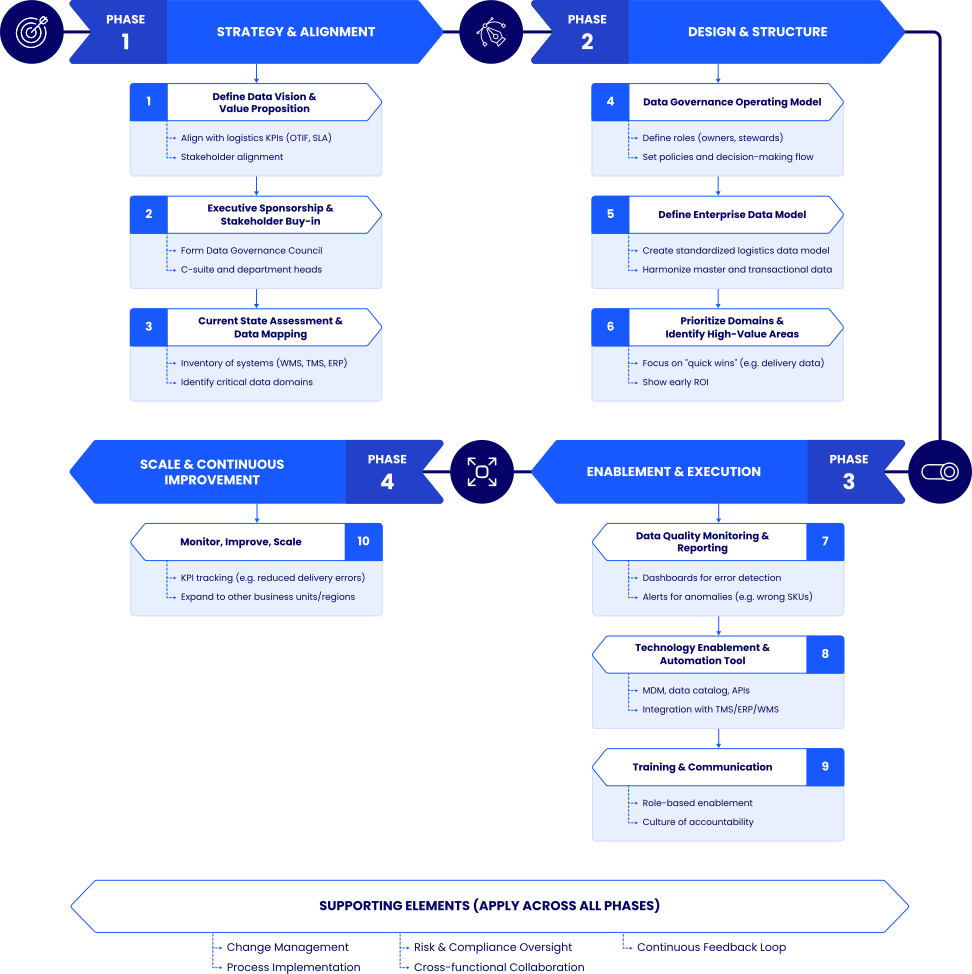
To give you a deeper view into how governance moves from strategy to execution, the following framework outlines the phased rollout we executed with this logistics client. Working together with the leadership team, X-Venture provided the strategy and change management, while the XAPI platform powered API governance, transparency, and control at scale.
Built to Evolve, Not Just to Last
In today’s dynamic business environment, the goal shouldn’t be to create a finance data model that simply lasts, but one that evolves. Flexibility, adaptability, and foresight are the new standards.
That means investing time up front to define a finance data strategy that includes:
- An enterprise information model that supports today’s needs
- Room for structural changes, such as reorganizations, new markets, and regulatory & technology shifts
And just as important, it requires a governance model that allows you to track, test, and tune your data long after go-live. Clean, consistent, and continuously monitored.
Because great governance doesn’t just support transformation. It sustains it.
At X-Venture, we help you become future-proof by aligning data and AI governance to your business goals, infrastructure, and compliance environment. Whether you’re building from scratch or refining what’s in place, we’re here to make governance work for you - now and tomorrow.
Let's Talk

Marketing Team
Partner - API, AI & Data Governance
- info@x-venture.io
- (+94) 77 40 86 590
We build. We fix. We future-proof
Click to rate this post!
[Total: 0 Average: 0]
Contact
Thank you for interested in reading content more. Please fill the following form to continue
Related Posts
X-Venture partners with Solace to drive real-time data and agentic AI across APAC & EU
- Guest Author
- 25 May 2026
X-Venture, is excited to announce its partnership with Solace, the real-time data and agentic A ..

APIs: The Invisible Power Behind Business Growth – And How to Secure & Monetize Them
- Guest Author
- 8 May 2026
“Do You Know Why the API Economy Is Booming Like Never Before?” Download PDF The Burning Pr ..